

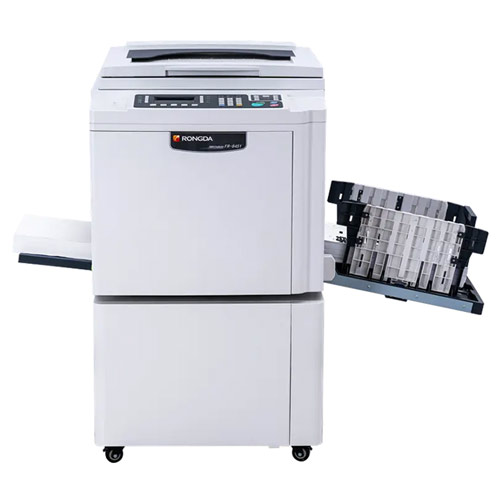
RONGDA FR-8451 A3 Digital Duplicator Machine
Regular Price:৳675,500.00Availability: SKU: 1.7.53.8459
Quick Overview
-
Support
Saturday – Thursday: 09 AM - 06 PM. -
Payment
Cash on Delivery | Card | Online Payment -
Shipping Cost
Inside Dhaka 500tk | Outside Dhaka 1000tk -
Warranty Policy
Read More
Description
RONGDA FR-8451 A3 Digital Duplicator Machine Price in Bangladesh
When an organization needs to produce a large number of copies of the same document, the right printing technology can make a major difference to productivity and operating cost.
The RONGDA FR-8451 A3 Digital Duplicator Machine is designed for exactly this type of high-volume duplicating environment. Rather than functioning like a conventional office photocopier, a digital duplicator creates a master from the original document and then uses that master for repeated printing. This makes the technology particularly relevant to schools, educational institutions, government offices, training centers, religious institutions, businesses and other organizations where the same documents may need to be reproduced in large quantities.
RONGDA places the FR-8451 within its FR Series of digital duplicators. The manufacturer's official product and download resources specifically list the FR-8451 alongside the FR-8251 and FR-8351 models, with dedicated FR-8451/8351 product documentation available.
For the Bangladesh market, the product is particularly relevant wherever the requirement is not simply "printing a document" but printing hundreds or thousands of copies efficiently.
Think about an educational institution preparing examination papers. A conventional multifunction printer can certainly produce copies, but when the volume becomes substantial, the economics and workflow can become less attractive. A digital duplicator is designed around that exact scenario.
The same principle applies to office circulars, training materials, notices, forms, handouts, worksheets, questionnaires and other repetitive documents.
What Is a Digital Duplicator?
A digital duplicator is a specialized high-volume printing system that combines digital document processing with stencil-based duplicating technology.
The workflow is different from that of a conventional laser printer.
The original document is processed to create a master. Once the master is prepared, the machine can reproduce the same content repeatedly.
That approach becomes particularly useful when the required quantity is high.
For example, printing 20 copies and printing 2,000 copies are very different jobs.
For a small quantity, a normal office printer may be perfectly adequate. For large repetitive print runs, a dedicated duplicator can be a much more appropriate production tool.
This is why digital duplicators are commonly associated with schools, colleges, examination departments, government offices, churches, mosques, NGOs, associations, training organizations and commercial print environments.
RONGDA itself specializes in digital duplicator machines and related office and post-printing equipment. Its official website lists duplicators across A3, A4 and B4 categories and separately identifies the newer FR Series.
A3 Printing Capability
The RONGDA FR-8451 is positioned in the A3 digital duplicator category.
That matters for organizations that need to produce documents larger than standard A4.
A3 support opens up additional applications such as:
- A3 educational materials
- Training documents
- Posters
- Charts
- Notices
- Brochures
- Worksheets
- Institutional forms
- Large-format office documents
- Folded publications
For educational institutions, A3 capability can be especially useful when teaching materials or examination-related documents require larger layouts.
Instead of treating the machine simply as another office printer, it is better to think of it as a production-oriented duplicating system.
Designed for High-Volume Repetitive Printing
The real value of a digital duplicator becomes obvious when the same document needs to be printed repeatedly.
Imagine a school preparing 1,000 copies of an examination paper.
Or a university preparing large quantities of lecture materials.
Or a government department distributing a circular to multiple offices.
Or a training center preparing hundreds of course handouts.
In these situations, printing speed is only one part of the equation.
The machine must also be suited to repetitive operation, economical use of consumables and consistent reproduction.
The FR-8451 belongs to a product family specifically designed around this type of duplicating workflow. RONGDA's official product resources categorize the model under its digital duplicator range, while current market listings describe it as a fully automatic digital stencil printing and duplicating machine.
Why Digital Duplicating Can Make Sense
A common mistake is to compare a digital duplicator directly with a standard laser multifunction printer simply by looking at the purchase price.
That is not always the right comparison.
The more meaningful question is:
How many pages do you need to produce, how frequently do you produce them, and how repetitive are those print jobs?
For low-volume office printing, a normal multifunction printer may be more versatile.
For large repetitive print runs, a duplicator can become much more appropriate.
This distinction is particularly important in Bangladesh, where schools, coaching centers, madrasas, colleges, universities, government organizations and businesses may need to reproduce large volumes of documents regularly.
Digital Duplicator for Schools in Bangladesh
Educational institutions are among the most natural applications for a machine like the RONGDA FR-8451.
Schools regularly need:
- Examination papers
- Class tests
- Worksheets
- Homework sheets
- Question papers
- Notices
- Training materials
- Student handouts
- Academic forms
- Administrative documents
The requirement becomes especially demanding during examination periods.
Instead of sending large quantities of documents to an external print shop, an institution can maintain its own high-volume duplicating workflow.
That can offer greater control over document handling and scheduling.
It can also reduce dependence on external printing services when documents need to be reproduced quickly.
Ideal for Examination and Question Paper Printing
One of the strongest commercial search-intent opportunities for this product in Bangladesh is exam paper printing.
Schools, colleges, universities and coaching centers regularly produce large quantities of educational documents.
A digital duplicator is particularly suitable when one master document needs to be reproduced many times.
For example:
Original question paper → Master creation → High-volume duplication → Distribution
This workflow is fundamentally different from printing every copy individually through a conventional office printer.
For organizations with regular examination workloads, that distinction can be significant.
Suitable for Coaching Centers
Bangladesh has a large coaching and training ecosystem.
Coaching centers frequently distribute:
- Model tests
- Question banks
- Practice sheets
- Class notes
- Study materials
- MCQ papers
- Examination papers
- Revision materials
A high-volume duplicator can support this type of repetitive document production.
The RONGDA FR-8451 therefore has a natural use case for coaching centers that regularly need to produce large batches of educational material.
Useful for Government and Institutional Offices
Government departments and institutional offices often produce large quantities of identical documents.
Examples include:
- Circulars
- Notices
- Internal forms
- Training materials
- Meeting documents
- Administrative forms
- Awareness materials
- Information sheets
A digital duplicator can be considered when these documents need to be reproduced in substantial quantities.
For departments with centralized printing requirements, this type of machine can serve as a dedicated production device rather than tying up standard office printers.
Useful for Corporate Training
Large companies also produce repetitive documents.
Training departments may need hundreds of copies of the same course material.
HR departments may prepare employee forms.
Sales departments may distribute product information.
Operations teams may reproduce internal notices.
In these cases, a high-volume duplicator can complement conventional office printers.
Master and Ink-Based Duplicating Workflow
One of the fundamental characteristics of a digital duplicator is its use of a master and duplicating ink workflow.
RONGDA's official website separately lists INK and MASTER ROLL as dedicated consumable categories for its duplicator products.
This is an important consideration for buyers.
A duplicator is not simply another toner-based multifunction printer.
Before purchasing, organizations should consider:
- Master roll availability
- Compatible duplicating ink
- Consumable cost
- Service support
- Operator training
- Preventive maintenance
- Spare parts availability
For Bangladesh customers, reliable access to consumables and technical support should therefore be part of the purchasing decision.
RONGDA FR Series
The FR-8451 belongs to RONGDA's newer FR Series.
The official RONGDA product center lists:
- FR-8251
- FR-8351
- FR-8451
under the FR Series.
RONGDA also maintains downloadable documentation specifically for the FR-8451 and FR-8351.
This is useful from a service and product-support perspective because buyers can identify the exact model and corresponding documentation rather than relying on generic duplicator information.
Production-Oriented Design
A digital duplicator should be viewed as production equipment.
Its job is not to replace every printer in an office.
Instead, it should take responsibility for a specific type of workload:
high-volume, repetitive document reproduction.
That makes the FR-8451 potentially valuable as part of a broader document-production environment.
For example, a school may use:
Laser MFP → scanning and occasional printing
while using:
RONGDA digital duplicator → high-volume repetitive printing
This division of workload can be more practical than asking one machine to handle every printing requirement.
A3 Duplicating for Larger Documents
A3 support adds another layer of flexibility.
Many institutional documents are produced in A4, but some applications benefit from larger paper.
A3 can be useful for:
- Large worksheets
- Charts
- Educational diagrams
- Notices
- Posters
- Training materials
- Folded publications
- Larger administrative documents
The larger paper format can also be useful when the final document is intended to be folded into a smaller finished size.
A Practical Machine for Bangladesh
The Bangladesh market has a very specific need for machines that can handle repetitive document workloads.
A school in Dhaka may need thousands of examination papers.
A college outside Dhaka may need regular class materials.
A coaching center may print hundreds of model-test papers every week.
A government office may reproduce circulars and forms.
A training institute may distribute course materials to every participant.
These are exactly the situations where a digital duplicator should be evaluated differently from a standard office printer.
Why RONGDA?
RONGDA has been manufacturing digital duplicators and other office/post-printing equipment since 1988, according to the company's official website. The company states that it serves markets across six continents and more than 40 countries, and Bangladesh is specifically included in its listed markets.
That gives the brand a meaningful background in the duplicator category.
RONGDA also states that it specializes in digital duplicators, shredders, offset presses, folding machines and other office/post-printing equipment.
For a buyer, specialization matters.
A company focused on duplicating equipment is different from a general printer manufacturer that happens to offer one duplicator model.
What Makes the FR-8451 Different from a Normal Photocopier?
This is an important question for customers.
A conventional photocopier is generally designed as a multifunction office device.
It may offer:
- Copying
- Scanning
- Printing
- Duplexing
- Document finishing
A digital duplicator has a different priority.
Its core purpose is high-volume reproduction of repetitive documents.
The RONGDA FR-8451 should therefore be considered when the customer has a substantial recurring duplication requirement.
If a customer only needs 10 or 20 copies of documents occasionally, a standard multifunction printer may be more appropriate.
If the customer regularly needs hundreds or thousands of copies, a digital duplicator deserves serious consideration.
Security and Confidential Document Workflow
For schools and institutions, document confidentiality can also matter.
When sensitive examination papers are outsourced to third-party print shops, the organization has less direct control over the physical production process.
An in-house duplicating system can allow authorized staff to manage the production workflow internally.
This can be particularly relevant for:
- Examination papers
- Internal assessment papers
- Confidential notices
- Staff documents
- Institutional forms
The actual security of the process, of course, depends on the organization's operating procedures and access controls.
Who Should Consider the RONGDA FR-8451?
The strongest candidates are organizations with regular high-volume repetitive printing requirements.
Schools
For examinations, worksheets, notices and teaching materials.
Colleges and Universities
For academic materials, examination documents and institutional publications.
Coaching Centers
For model tests, question papers and student handouts.
Government Offices
For forms, circulars and internal documentation.
NGOs
For training materials, forms and field documentation.
Corporate Training Centers
For repeated course materials and participant handouts.
Printing Departments
For organizations operating an internal document-production department.
Important Buying Consideration
Do not purchase a digital duplicator simply because it has a lower per-page cost or because it is marketed as a "high-speed printer."
First calculate the actual workload.
Ask:
How many pages are printed every month?
How many pages are usually from the same original?
Are the jobs repetitive?
Do you need A3?
Can the organization manage master and ink consumables?
Is technical support available locally?
These questions will tell you whether the FR-8451 is genuinely appropriate.
Why Buy RONGDA FR-8451 from BME?
For a specialized production machine, after-sales support is just as important as the machine itself.
BME can provide customers with product guidance based on their actual printing requirements rather than simply selling the machine.
Before purchasing the RONGDA FR-8451, customers should discuss:
- Intended monthly volume
- Required paper size
- Type of documents
- Master roll requirements
- Ink requirements
- Installation
- Operator training
- Warranty
- Maintenance
- Spare parts
- Service support
This is especially important for institutional customers purchasing the machine for long-term operation.
Buying Guide
1. Estimate Monthly Volume
Calculate the approximate number of pages produced every month.
2. Identify Repetitive Jobs
The more copies you produce from the same original, the more relevant a digital duplicator becomes.
3. Confirm A3 Requirement
If A3 printing is important, confirm the exact paper-size capability and configuration before purchase.
4. Plan Consumables
Master roll and duplicating ink are essential parts of the operating model. RONGDA officially lists both as duplicator consumable categories.
5. Consider Operator Training
A digital duplicator is specialized equipment. Proper operator training helps maintain print quality and machine performance.
6. Consider Service Support
For schools, government offices and commercial printing departments, downtime can become expensive. Confirm warranty and service arrangements before ordering.
Frequently Asked Questions
What is RONGDA FR-8451?
The RONGDA FR-8451 is a digital duplicator from RONGDA's FR Series, designed for high-volume stencil-based document reproduction.
Is RONGDA FR-8451 an A3 digital duplicator?
Yes. It is positioned in the A3 digital duplicator category.
Is FR-8451 a photocopier?
It is better described as a digital duplicator or digital stencil duplicator, rather than a conventional multifunction photocopier.
What is the main use of RONGDA FR-8451?
Its main purpose is high-volume reproduction of repetitive documents such as examination papers, worksheets, forms, notices and training materials.
Is RONGDA FR-8451 suitable for schools?
Yes. Schools and educational institutions are among the most relevant applications for high-volume duplicating equipment.
Can it be used for examination paper printing?
Yes. High-volume examination and question-paper production is a natural application for a digital duplicator.
Is it suitable for coaching centers?
Yes. Coaching centers can use a digital duplicator for model tests, worksheets, question papers and other repeated educational materials.
Does RONGDA provide master rolls and ink?
RONGDA's official website lists INK and MASTER ROLL as dedicated consumable categories for its duplicator products.
Is RONGDA a manufacturer?
Yes. RONGDA's official website identifies Ningbo Rongda Imagine & Intelligent Manufacture Technology Co., Ltd. as a manufacturer specializing in digital duplicators and other office/post-printing equipment.
When should I choose a digital duplicator instead of a laser printer?
A digital duplicator is worth considering when you regularly produce large quantities of the same document. For small or varied print jobs, a multifunction printer may be more appropriate.
Does FR-8451 support A3?
The model is positioned by RONGDA as an A3 digital duplicator. Exact paper-size and configuration details should be confirmed against the supplied regional machine documentation before publishing detailed technical figures.
RONGDA's official resources confirm the FR-8451 model, FR Series classification, and dedicated consumable categories. RONGDA FR-8451 is an A3 digital duplicator from RONGDA's FR Series, designed for high-volume repetitive document reproduction such as examination papers, worksheets, forms, notices, training materials and institutional documents.
What is the price of RONGDA FR-8451 A3 Digital Duplicator Machine in Bangladesh?
Write a review
Question Answer
Have question about this product? Get specific details about this product from expert.

RONGDA JR-7360S A3 Digital Duplicator Machine
Rongda JR-2361S B4 Digital Duplicator Machine
RONGDA FR-8451 A3 Digital Duplicator Machine
RONGDA JR-7360S A3 Digital Duplicator Machine
Rongda JR-2361S B4 Digital Duplicator Machine

RONGDA VR-2335S Digital Duplicator Machine

RONGDA VR-7315S Digital A3 Duplicator Machine
RONGDA FR-8451 A3 Digital Duplicator Machine


Rongda VR-231 Digital Duplicator Machine

RONGDA VR-4345S B4 Digital Duplicator Machine


